My mechanical keyboard journey
For years, the Apple Magic Keyboard was my default since I got my first MacBook in 2014. In 2022, I was checking out Logitech’s keyboards and got the MX Keys Mini. It felt like a step up for a while until I noticed how the pronounced, tactile feel added friction and slowed me down. I came back to the familiar, flat, and fast Magic Keyboard before eventually taking the plunge into mechanical keyboards.
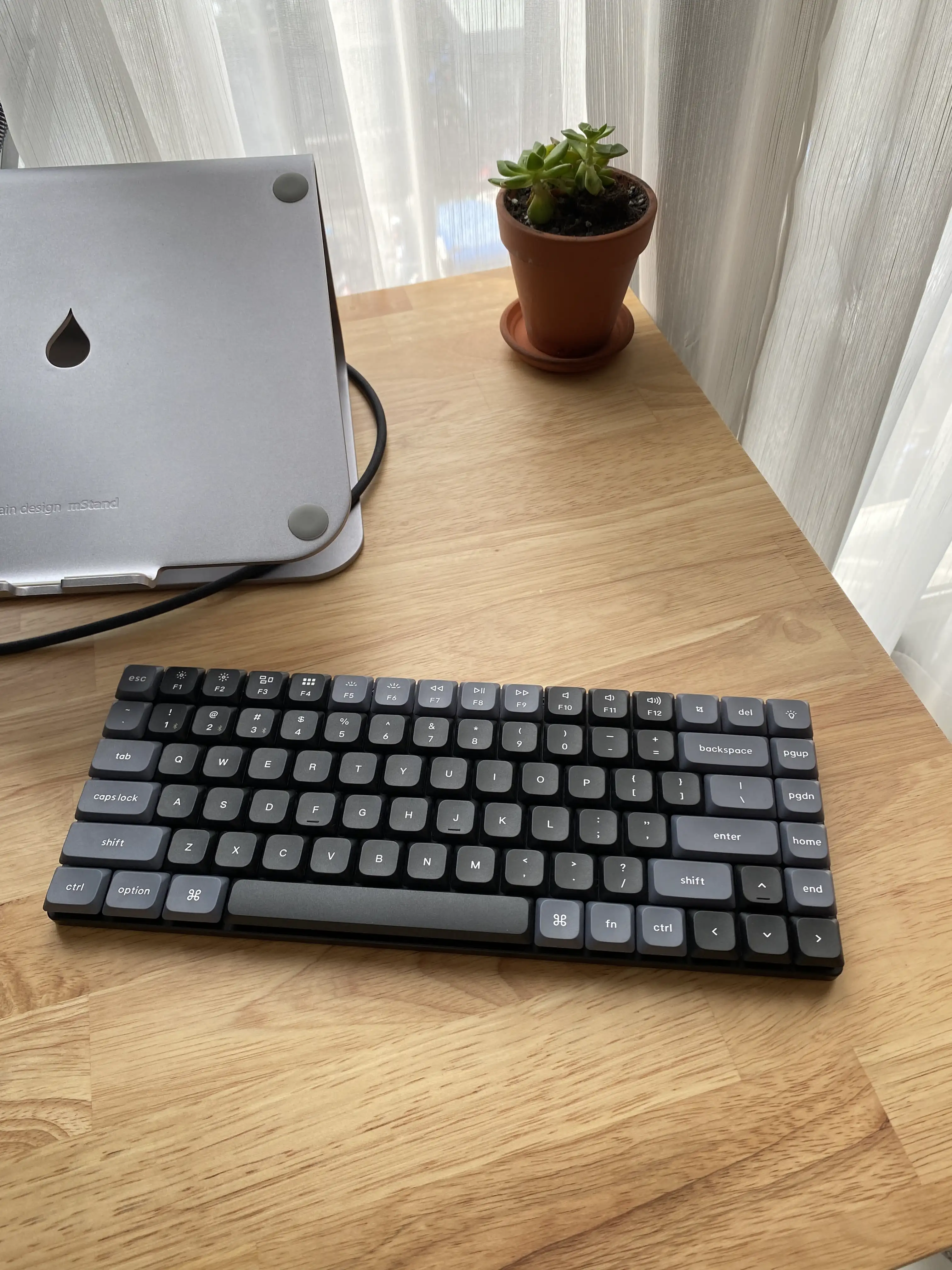
My first (failed) attempt at mechanical keyboards was the Keychron K3 v2 with brown tactile switches back in October 2021, about half a year before I got the MX Keys. I bought it on impulse because my friend had one. It did not stick. I remember thinking, “Maybe this isn’t my cup of tea.” In hindsight, it wasn’t the keyboard itself but mainly the tall keycaps which felt unfamiliar, and the tactile switches which felt jarring. After a few days, I went right back to my space gray Magic Keyboard with numeric keypad (the best Apple keyboard in my opinion) and sold off the K3 a few weeks later.
In July 2023, FOMO got me again and I picked up the Keychron K3 Pro with red linear switches. This time it clicked, literally and figuratively. The typing felt smoother, the sound was softer, and I finally understood why people get hooked on mechanical keyboards. I think it was mostly the linear switches that made all the difference, and this keyboard got me officially into mechanical keyboards.
The detours #
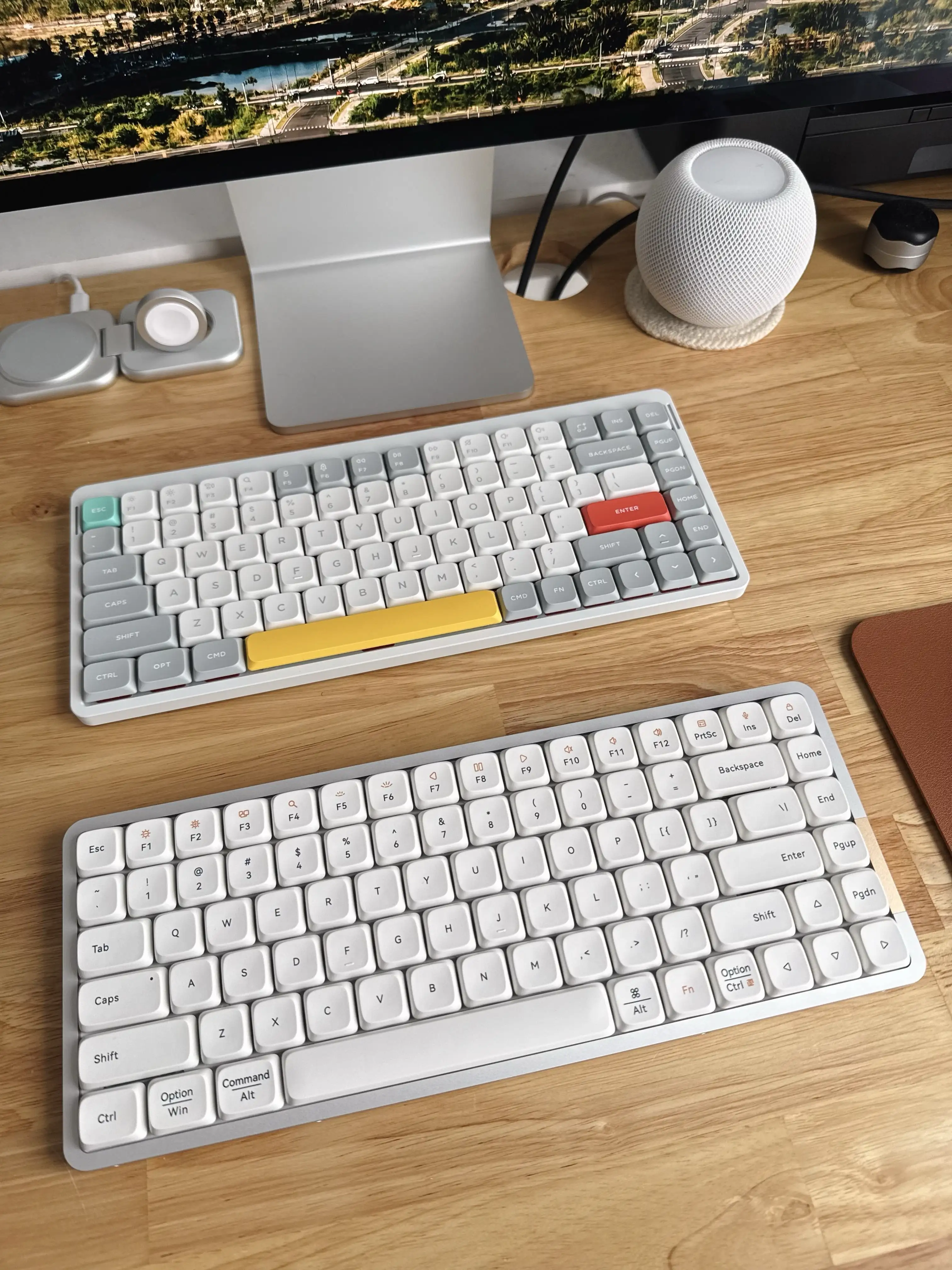
Just a month after I got the K3 Pro, the NuPhy Air75 v2 got my attention and I decided I had to have it. The beautiful, playful design and vibrant colors were appealing, and the Raspberry linear switches produced a satisfying thock. I even got the NuPhy Air 60v2 with Wisteria tactile switches for my work setup, but the layout quickly felt cramped and I made too many typos with the small right Shift key. Plus, I realized I was very much a linear switch person. At this point, I was trying to figure out what I valued most: looks, feel, build quality, or sound.
Then came the Lofree Flow, a low-profile body with high-profile acoustics and an Apple-like aesthetic. This was a year after I got the Air75, I was getting kind of bored of it. The richer acoustics made the Air75 feel flat and a little bit cheap. I liked the Lofree Flow with Ghost linear switches so much that I got a second one with Phantom tactile switches for my office setup.
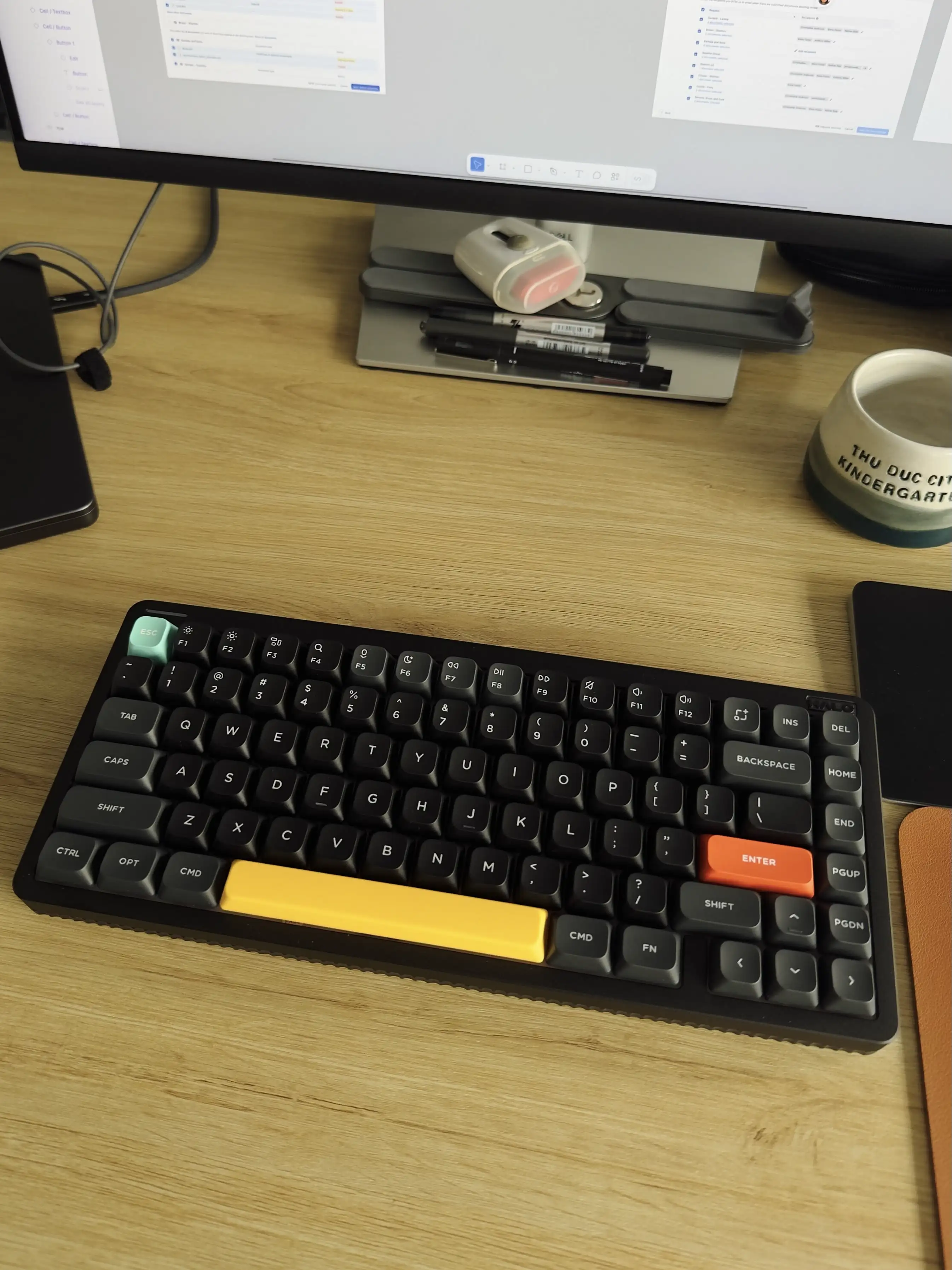
After encountering connectivity issues with both the Lofree Flows, I figured: why not go high-profile all the way instead of chasing “close-enough” acoustics? After watching some reviews, I went with the NuPhy Halo75 v2. Almost immediately, I knew I was never going back to low-profile. I missed the seamless experience I had with NuPhy keyboards. The Halo’s creamy thock was particularly satisfying, and the build quality felt solid compared to its low-profile counterparts. A couple of months later, I got my hands on the NuPhy Kick75 and was even more impressed. The volume knob was a feature I didn’t know I would appreciate. I thought this setup was endgame for me, until one day.
A new baseline #
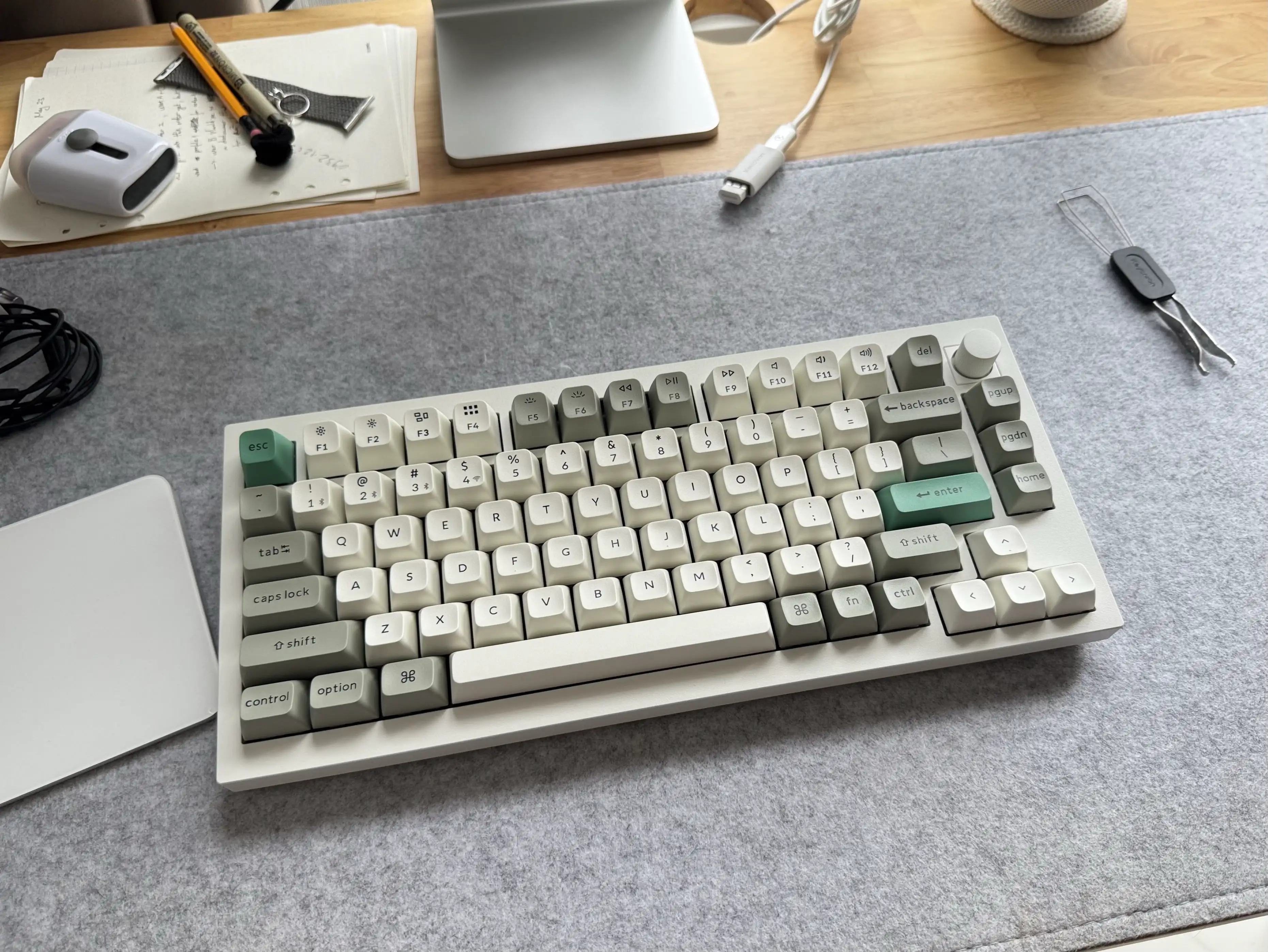
Enter the game changer: Keychron Q1 Max. It’s my most expensive keyboard so far, and it completely reset my baseline. I got it mostly out of curiosity, I was happy with the NuPhy Halo at the time. But the acoustics on the Q1 Max are just on another level, and once I experienced it, I couldn’t unhear the hollowness on the NuPhy. The all-aluminum construction makes the keyboard feel like a tank. The Shell White colorway feels elegant and sophisticated compared to the toy-like appearance I was starting to see in all NuPhy keyboards. (Look at that, I finally use the word “colorway” — something I thought only snobs would say.) The tall KSA keycaps were a concern at first, but they’ve completely won me over with their sculpted profile and height that improves my typing accuracy substantially compared to the flatter and rounder mSA keycaps on the NuPhy Halo75.
I usually like to have the same keyboard at work and at home (in different colors) for a consistent experience. But this time, instead of getting another Q1 Max for the office, I wanted to experiment with having variety. After selling off the NuPhys, I got the Keychron V1 Max. It’s basically a budget Q1 Max, I found a shop that had the last one at a discount — 1.85M VND or $70 (it usually retails at 2.4M VND or about $100). Despite being primarily plastic, this keyboard punches way above its class and doesn’t feel cheap at all. The OSA keycaps are slightly shorter than the Q1 Max’s KSA but still sculpted enough to allow me to type comfortably and accurately. I’m loving this keyboard much more than I anticipated, and it’s more affordable than most of the low-profile keyboards I owned before.
Where I’m at now #
The setup I’ve landed on recently is: a premium Q1 Max at home, a budget V1 Max at the office. This saves money while still giving me quality in both places, plus the variety helps shift my mindset depending on where I’m working. Funny enough, I started with Keychron, then went on a couple of detours, and now I’m back right where I began.
I know people who stick with the same gear for years and don’t have the need to switch until their current gear breaks. Sometimes I wonder if I’m too impatient, not giving myself ample time to ease into a new experience, because maybe what feels “wrong” at first is just “different.” But every time I upgrade, I end up happier and more satisfied, so it feels less like I’m wasting time and more like sharpening taste.
Through this little journey of finding the next perfect keyboard, I learn a thing or two about my preferences. Perhaps more surprisingly, I’ve learned to let go of the idea of having identical setups because variety, as it turns out, can be more valuable than uniformity. Who would’ve thought?